An iconic hotel. Invisible in search.
Downtown Luxury Hotel sits on one of the most recognizable streets in its major metro market, with a rooftop bar that's featured on more travel lists than almost any venue in the city. It's exactly the kind of property that should be showing up when travelers search "where to stay in [major metro]."
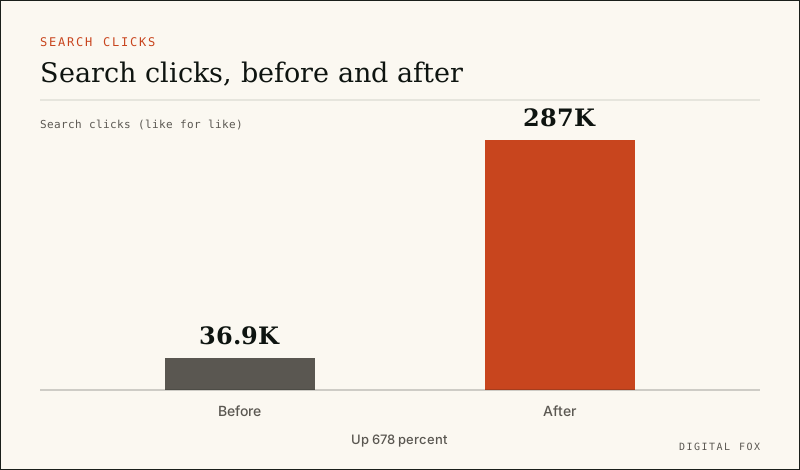
It wasn't. In the baseline year, the site averaged position 21.1 on Google and just 264 search clicks per day, and its visibility was essentially one query wide: the brand's own name. "[brand name]" alone drove 24,719 clicks at position 3.0, and "[brand name] [city]" added another 3,825 at position 3.5. People who already knew the property name were finding the site. Everyone else was finding competitors.
The keyword footprint told the same story: it had been sliding toward the 7,000 to 10,000 range, with effectively zero non-branded presence. The property had world-class brand equity and shrinking search visibility.
What we did: 245 long-form guides in six months, with a technical rebuild underneath.
The engagement opened with a 90-day content blitz, then pivoted to what travelers actually search before a trip. The goal: publish enough local travel content, with the technical SEO underpinnings to support it, to turn the property into a go-to answer for anyone planning a trip to the region.
01 · High-frequency blog engine
245 long-form travel guides published in six months. The first 90 days were a content blitz: high-volume, long-form destination guides with manual index requests on every URL so Google saw each new piece within hours, building E-E-A-T domain trust fast. The program then pivoted to travel intent: holiday fireworks, a state visit, citywide festivals, seasonal events, and hotel deals.
02 · Search intent mapping
Identified high-volume, low-competition local queries before writing a single word. Every guide targeted a specific search intent, not a general topic: holiday event schedules, seasonal festival dates, walking tour routes, distances between major landmarks.
03 · On-page SEO & schema
Every page structured for featured snippet targeting: concise answers, FAQ schema, Article schema, and rigid H1/H2 hierarchy. 100% of URLs hit Google's "Good" rating for Core Web Vitals.
04 · Internal link architecture
Thousands of internal links built across the content program, connecting every travel guide back to bookable pages: rooms, suites, spa, hotel deals. Content as a conversion path, not just content as traffic.
The query shift: from brand-only to "seasonal festival."
The single most visible evidence of what happened appears in the Search Console query data. In 2025, every top query was a variant of the brand name. In 2026, informational travel queries dominate the top of the list: the property is being found by people who don't yet know the brand exists.
| 2025 · Top Queries (Branded Only) | ||
|---|---|---|
| Query | Clicks | Avg. Pos. |
| [brand name] | 24,719 | 3.0 |
| [brand name] [city] | 3,825 | 3.5 |
| 2026 · Top Queries (Topical & Informational) | ||
|---|---|---|
| Query | Clicks | Clicks in 2025 |
| what state is [city] in | 6,982 | 0 |
| when is [holiday] | 6,074 | 0 |
| where is [city] | 2,611 | 0 |
| [city] | 2,425 | 0 |
| is [city] a state | 2,299 | 0 |
Source: Google Search Console, Mar 13 – Jul 12, 2026 vs. same period 2025.
In 2025, Downtown Luxury Hotel was found by people already searching for it. In 2026, it's found by anyone curious about the city. 92% of search clicks now come from non-branded queries, and 1,000+ queries across 290 pages earn clicks. That's the category shift: from a hotel that's on a shortlist to a hotel that gets on shortlists.
Four findings that explain the growth.
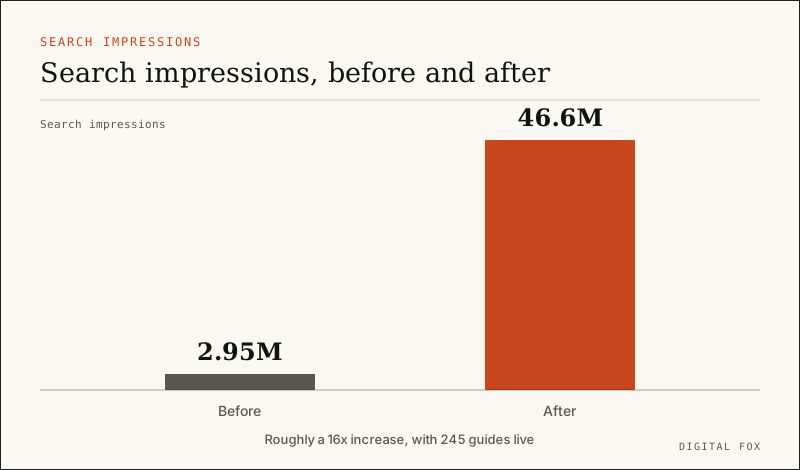
Impressions grew roughly 16x while clicks grew roughly 8x.
Impressions rose from 2.95M to 46.6M while clicks rose 678%. Google started showing the property to far more people before those people clicked through. That's authority being established: the property now appears for queries it never used to surface for.
Site-wide average position went from 21.1 to 7.4.
That's page one, site-wide, up from page two-three territory. 1,000+ queries and 290 pages now earn clicks, and the ranked-keyword footprint ran from roughly 10,000 in January to 45,000 in July, with a May peak of 103,000.
The query profile flipped.
92% of search clicks now come from non-branded queries. The property earned a #1 national ranking on a holiday query searched 90,500 times a month and page one for the city's own name, a term searched 450,000 times a month. And the halo is real: branded impressions rose 83%, with brand search interest at a five-year high on Google Trends.
Every visitor got pixeled.
In six months, 504,000+ new visitors were captured and cookied for retargeting via Google and Meta: new users grew 151%, from 200,871 to 504,351. Retargeting revenue is already up 62%, and the audience compounds every day the blog keeps publishing.
The invisible dividend: 504,000+ new visitors.
Most discussions of SEO stop at the click. They shouldn't. Every organic search visitor who lands on your site does two things: they read your content, and they get pixeled. From that moment they can be retargeted via Google Display, Meta, and programmatic for up to 540 days.
User sees your Instagram post
- 95%+ never click through
- You have no data on them
- Cannot show them display ads
- Invisible to your retargeting stack
- They book a competitor. Gone.
User finds your blog via Google
- Lands on your site → GA4 fires pixel
- Even if they bounce, they're tagged
- Google & Meta retargeting for 540 days
- They return. They book direct. You keep it.
- Audience database grows every single day
Downtown Luxury Hotel's 504,000+ new visitors in this six-month engagement are now all in an audience that keeps working long after they leave the site. Social followers can't be retargeted. Website visitors can. That's the second-order asset that never shows up on the case study deck.
One more dividend appeared during the engagement: a brand-new AI Assistant referral channel. Visitors arriving from ChatGPT and Gemini-type sources generated 1,718 sessions converting at a 34.5% key-event rate, the highest of any channel on the site, backed by 1.3K AI mentions and 1.1K AI-cited pages.
The takeaway.
Six months. 245 long-form guides. 8.9x the daily Google clicks. Organic traffic ran 3.3x the best prior year, the biggest same-period stretch on record, and now drives 57% of all traffic, up from 28%. Demand into the booking engine more than doubled: begin-checkout users grew 129%.
The ancillary business followed the same curve: wedding leads up 87%, meeting leads up 29%, spa leads up 59%. In total, $2.51M was booked through organic-fed channels, 65% of site revenue, with an estimated $580K+ in OTA commissions avoided. Organic traffic is now worth roughly $331K per month in equivalent ad spend.
The core insight: a hotel's search visibility can be transformed in six months, not a multi-year program, if you publish at the right velocity with the right technical foundation. And unlike ad spend, the result is a permanent asset: every guide published in this engagement stays live, keeps ranking, and keeps accruing authority. The next year's baseline will dwarf this one.